DESIGNERS TALK 03
When We Want to Try Something, We Make It Happen!
Expanding the Realm of Product Design, and Finding New Challenges
Work at the Design Center isn't limited to creating our products' designs. While Moto and Yoshiko are both in charge of some of our biggest brands, they've also been involved in the launch of a variety of new business projects. The Design Center is brimming with highly unique characters, and here we have two of the most colorful figures among them, talking about the true pleasures that lie within the art and science of craftsmanship — monozukuri.
Interviewed in 2022
Yoshiko FUJITA
Graduated from Kyushu University's Faculty of Design. Worked as a designer at a design office before joining Suntory in 2007. Yoshiko has been in charge of carbonated drinks for approximately 16 years, including the iconic lemon-flavored CC Lemon. While also being involved in the Product Development of other beverages, including wines and Iyemon tea, her range of work also extends to the design of Suntory businesses, including those among the New Business Project domain, and our D2C Services.
Moto MURAI
Graduated from Tama Art University's Department of Product and Textile Design, Product Design Course.
Joined Suntory in 2016. Moto has worked on carbonated drinks including Orangina, on non-alcoholic drinks
including ALL-FREE, and on beer-like beverages including Kinmugi,. He is currently primarily in charge of
CRAFT BOSS coffee, TAG-COFFEE STAN(D), and New Business Projects.
Outside of Product Development, he also creates visual media and plans events.
Index
-
Talk Topic 1
A Beer for Martians?
-
Talk Topic 2
How to Make Fun Things Materialize
-
Talk Topic 3
School Festival Vibes?
-
Talk Topic 4
"I have an idea!" "I can do it!" — It All Flows From There
-
Talk Topic 5
The Department Dedicated to "Bringing Ideas to Life"
-
Talk Topic 6
When It Comes To Product Development, We're The Best "Counterpart"
-
Talk Topic 7
We're Serious, But We Get Crazy. We Speak Rough, But We're Big Softies.
A Beer for Martians?
So, what brought you to Suntory?
I began my career by working at a design office, but I started to gradually feel an urge to become involved higher up the stream in the development of products. The first idea that sprung to mind was to become an in-house designer. If I didn't want to simply work in the technical aspects of design, but rather to be involved in Product Development from the Concept Creation stage, then I thought my only option was to become a designer for a manufacturer.
Wasn't working at a design office fun enough? You must've gotten to work not just on packages, but also on advertisements, logos, and a bunch of other media too, right?
When you work at a design office in Japan, what happens most of the time is that a client will give you an orientation, then it's your job to reflect their ideas in the design. But that's not all I wanted to do. I wanted to be involved in the development of a product from the very start — from the creation of the core value of a product. And fortunately enough, at Suntory the three main divisions — the Marketing Department, R&D, and the Design Center — actually do come together as one, to develop products from scratch. So, why did you join Suntory?
When I was in my fourth year at university, I went to a few recruiting seminars for some different companies, but none of them really felt right. I was wondering what to do, and was toying with the idea of going to graduate school, when my friend told me that the Suntory Design Center was looking for people. And the recruitment task was: "Make a proposal for a beer targeting Martians."
That task is so us!
I thought, "Okay, that sounds like fun." And I'd just finished reading a book, which I'd bought by chance from a used bookstore, that was called "The Secret of Natchan!."* (laughs) So, I already knew a bit about the Suntory Design Center. *"Natchan!" is an orange juice brand produced by Suntory. The abovementioned book provides a behind-the-scenes look at the development of Natchan!, and Suntory's approach to Product Development in general.
I read the same book myself when I was student! It's all about Product Design Development at Suntory, and I remember thinking, "Wow, so this is how products come to life." I recall being super impressed about how the team used what you might call "both sides of the brain" — they employed a lot of intuition and creativity, as well as critical, logical thinking. I'm sure that strikes a special chord for people like you and me, since we don't only go with our emotions and instincts, but we also like to get picky when it comes to things like rationalizing ideas.
That's true. And as I tackled the recruitment task, I realized it was actually a very well-thought-out challenge. I was thinking, "What would beer even mean to Martians?" "First things first — what are Martians?" It sent my mind racing all over the place, which I found both challenging and fun.
It might seem like a weird task, but it's actually quite profound.
How to Make Fun Things Materialize
In the old days, most of the work at the Design Center focused on Package Design, but as the times have changed, I feel that we've succeeded in expanding the role that we play.
It certainly has changed here a lot over the past few years.
Right? For example, I was involved in a project more than a decade ago where we were supposed to come up with ideas for the next generation of beverage vending machines. But nothing came to fruition. The ideas kept piling up, but nothing materialized. The mountain of proposal documents just kept getting bigger and bigger, until one day, the whole project fell through. I think the biggest problem was that it was supposed to be launched on a really large scale, which meant that we couldn't really be that adventurous.
But I heard some ideas for that project did actually materialize.
They did! I just don't want to talk about them. (laughs) We actually made the Eco-tori Vending Machine* and the Digital Signage Vending Machine. We installed Eco-tori Vending Machines in a bunch of different places, and we ran a campaign. We made a mascot costume, and I even got inside and played the character myself. I'm a total idiot... (laughs). As for the Digital Signage Vending Machine, it ended up being so expensive that we only made one of them. So, they both ended up being case studies in how to fail.
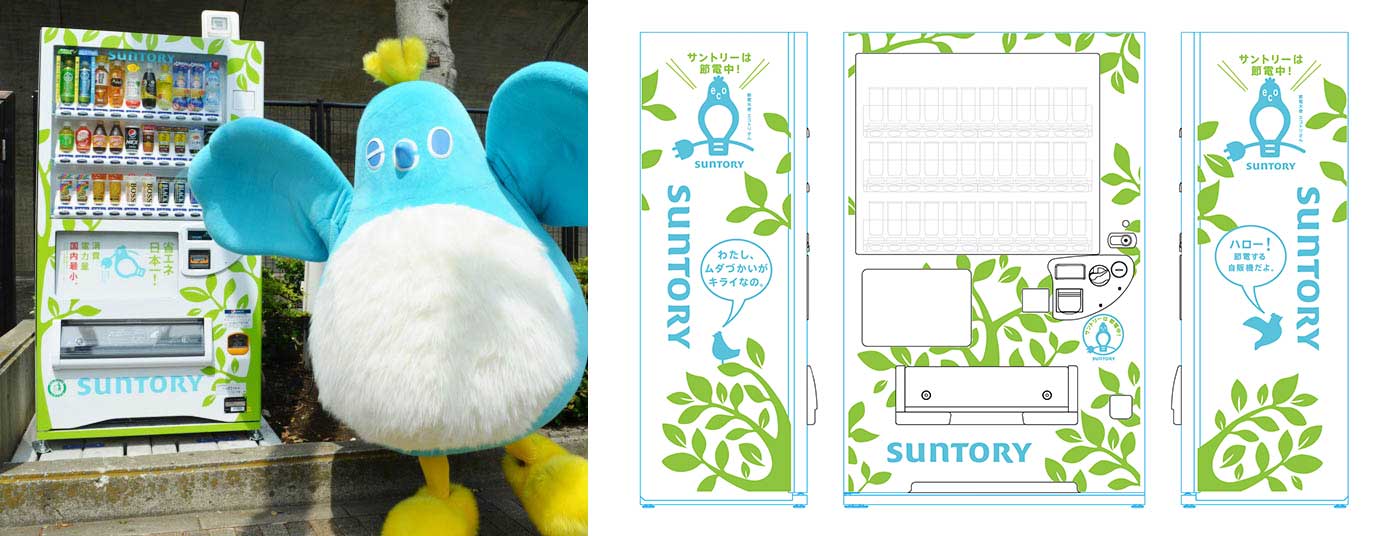
*The Eco-tori Vending Machine: We used a small bird motif to evoke the image of a "small eater" when designing Japan’s lowest energy consuming vending machine ("tori" means "bird" in Japanese.) My youthful exuberance led me to create many lovely messes.
I had no idea. (laughs)
We all have a past. But my point is that more recently we've created a system where we can start off small, just to try things out. We're able to create fun projects because we do it on a smaller scale. And a few of those innovative products have actually been released to the public. I think it's an extremely good thing.
Speaking of projects that ended up falling through, in 2019 I worked on the development of a Raise-a-Cat Vending Machine.
What? That didn't fall through. You actually made one.
Well, the project stopped halfway through when COVID-19 came... But we did make one prototype. The monitor of the vending machine was made to look like it was a miniature garden, and every time you pressed a button to buy something, a cat would appear with a "meow." Whenever someone bought something, another cat would come... I proposed the idea as a gimmick to motivate people to walk by vending machines. At the time, it felt like I was making pixel art of cats, and animating them, forever. (laughs)
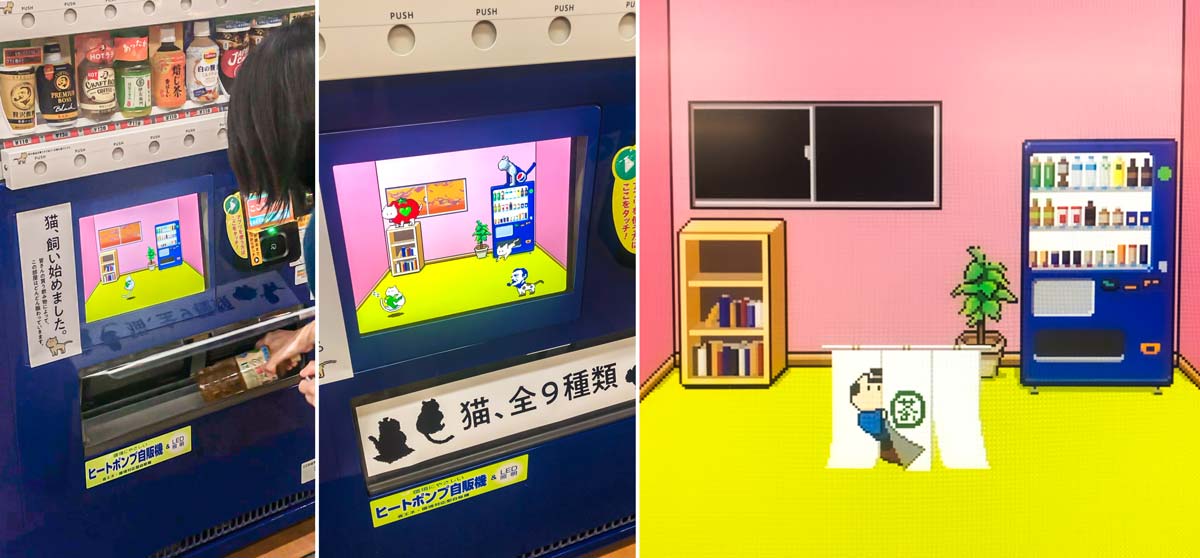
The “Raise-a-Cat Vending Machine”
Speaking of cats, you made Cat Caps too.
I did. It started off when the Social Media Manager from the PR Department said that they wanted to change the "SUNTORY" logo to a "NYANTORY" one to commemorate Cat Day* on February, 22. They wanted me to make the logo, but I thought the whole idea sounded lame, and I didn't want to do it. So I called the Social Media Manager and said, "Let's chat about it a bit first.” *"Nyan" is the Japanese word for "Meow," and it also sounds similar to the Japanese pronunciation of the number "2." Since the date February 22, or "2/22," sounds somewhat like "Meow, meow, meow," it makes for the perfect Cat Day.
You never want to work on a request that comes with a predetermined method — having a discussion about the objective first always yields much better results.
Exactly. So I said, "You want to do something related to cats, but it doesn't have to be a logo, right?" "Why don't we put cat ears on the bottle cap?" And the conversation kept going from there. I used putty to add ears to a bottle cap right then and there.
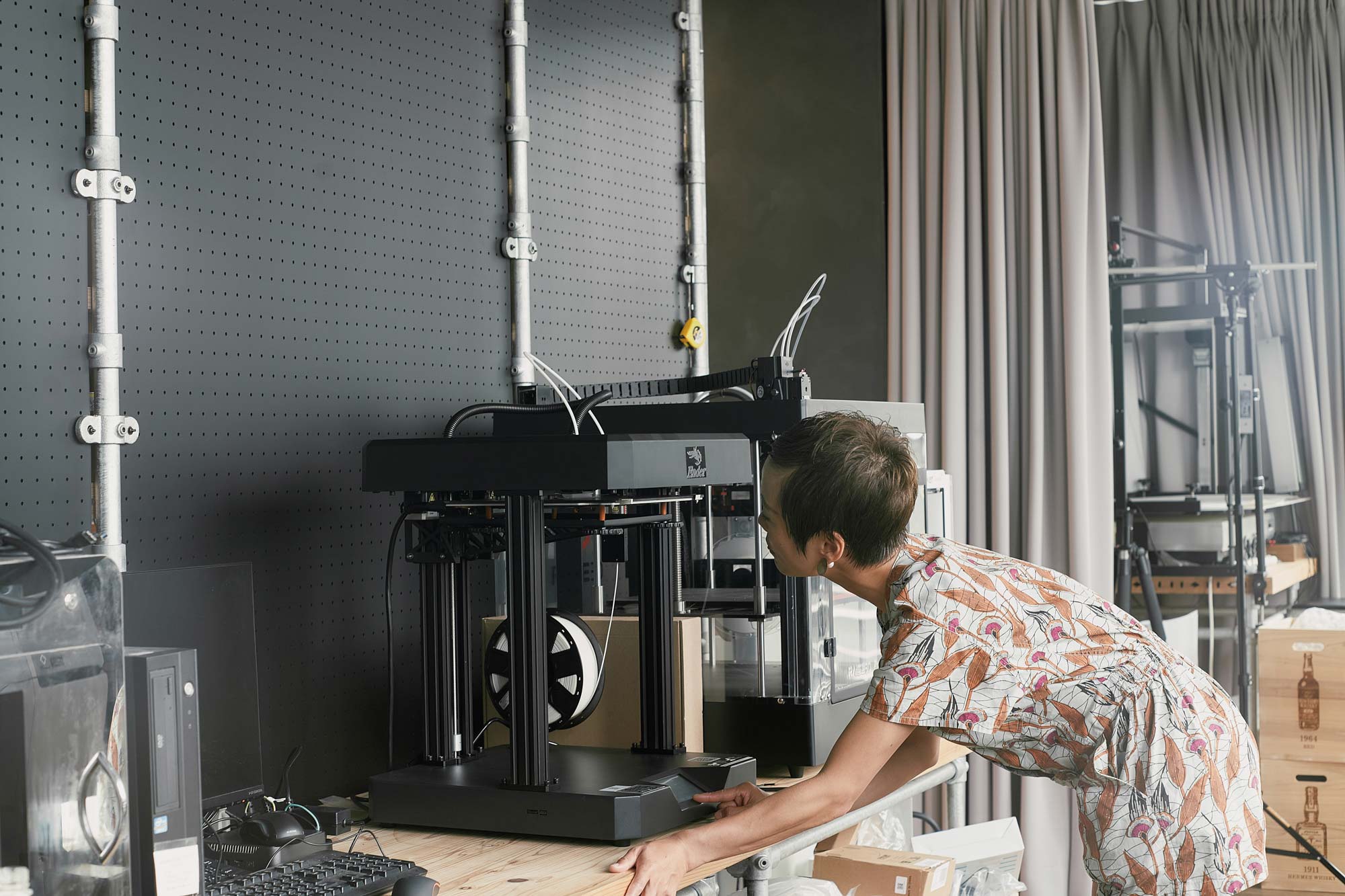
Yoshiko So that's how you ended up making prototypes with the 3D printer at the Design Center.
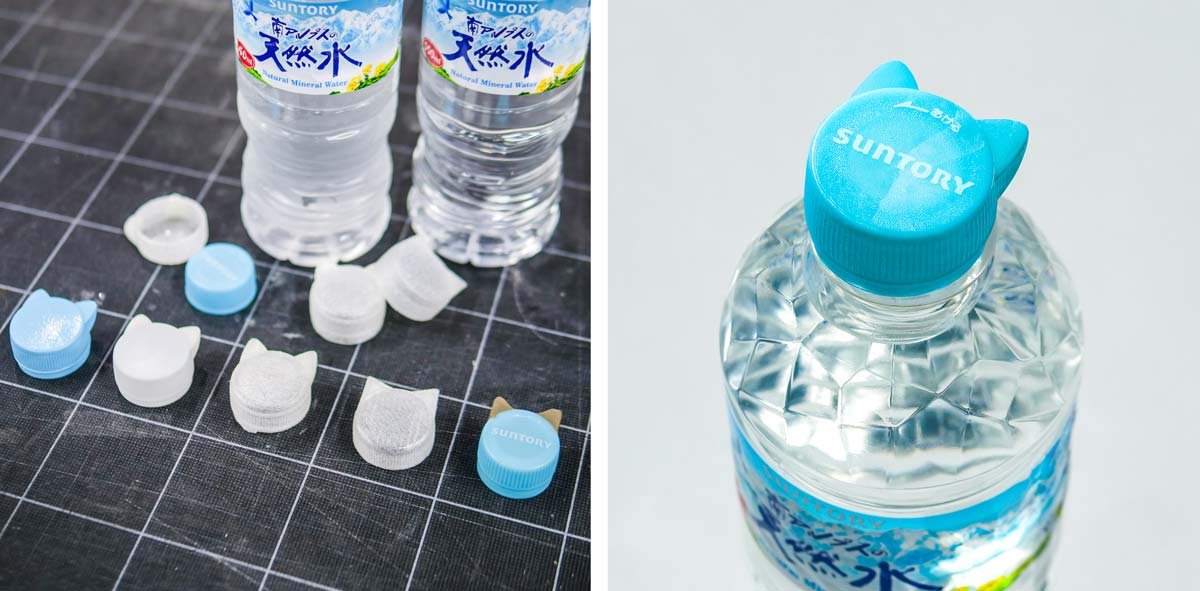
Cat Caps
School Festival Vibes?
The Cat Caps created a lot of buzz when we posted them on social media. We got a whole lot of comments from people saying they wanted them. And it wasn't just because they were cute — people were discussing the functionality of the caps too — "That's the perfect thing to stop your bottle from rolling away." "They look easier to open than normal caps, since you have something to grip onto." So, we improved the design to make it an "Opener" too.
In the beginning, they were all made by hand, right?
Yes, we kept printing them, over and over again, using the 3D printer in the Design Center's workshop. But all I did was the initial part — making the ears with the putty. The actual 3D data that we used was created by my boss! I thought, "I could try doing it myself, but if I asked them for help, it'll be a whole lot quicker, and end up prettier too... Okay, I'm going to rope them into this!" In the end, my boss made all of the data.
When you say "boss," you mean the head of the department at the time, right? I actually think he enjoyed really getting into it. (laughs)
In a normal company, it would probably be unthinkable for a subordinate to use their superior like that, but here, we do it all the time. If there's something you want to do, you involve whoever you need, whether it's your superior, your senpai, or your friend. You work the same way too, right?
All the time! It doesn't matter who's the senpai. Your position is irrelevant too. Whatever means you use, the thing that matters above all else is achieving high-quality output.
We do whatever it takes. But deep down, we're very serious people. (laughs)
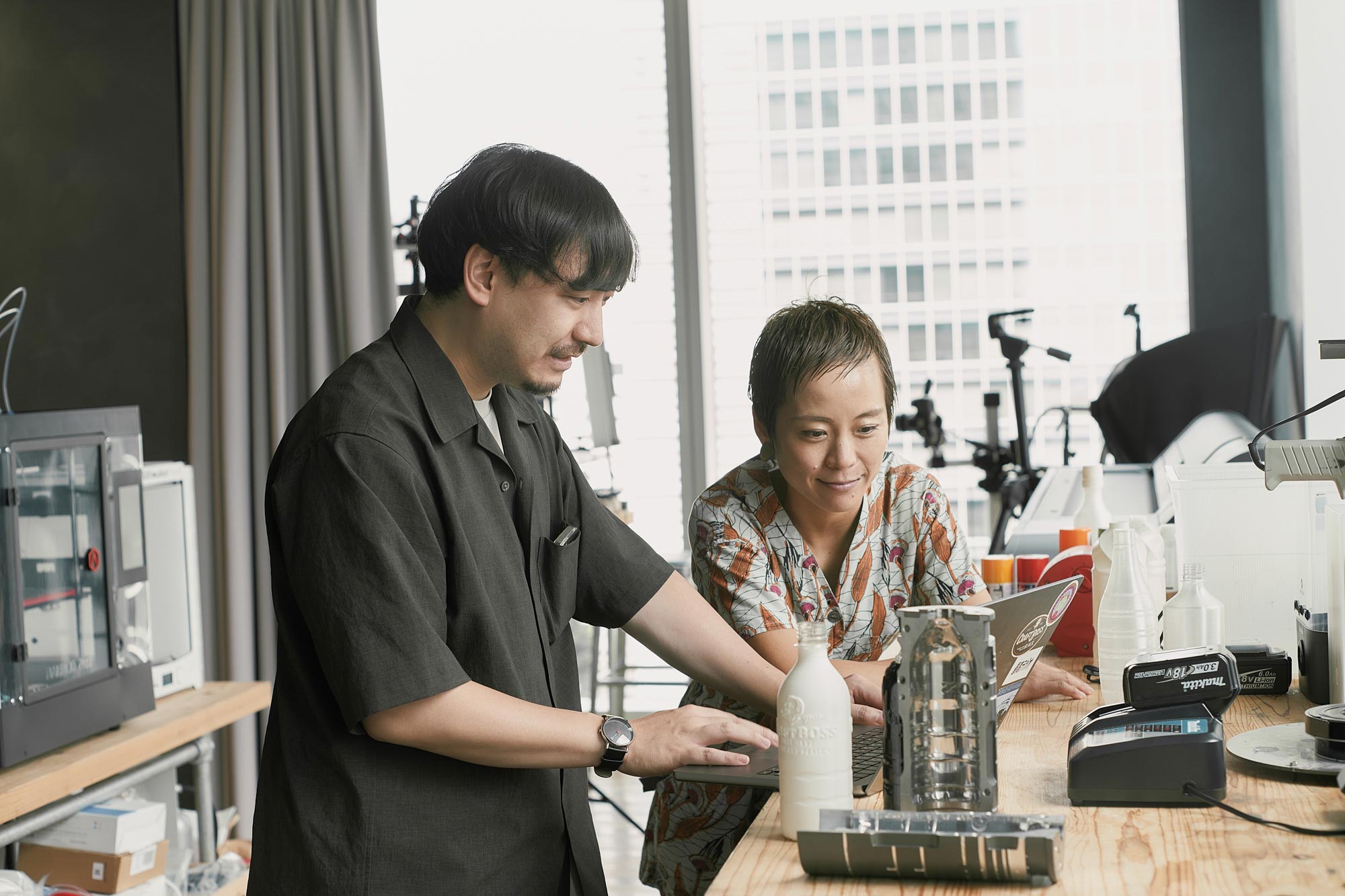
When it comes to projects in the New Business domain in particular, we'll often go, "Well, let's just try making it." The feasibility might be vague, and we'll have to sail through unchartered waters, but we steam on ahead, and make the boat by hand if we have to... We may be one of Japan's biggest companies, but we sure never shy away from getting into the nitty-gritty!
We'll boldly say, "We'll do it!" Then we really do have to give it our all.
I think that's how we've earned the trust we enjoy within the company — we're both daring and diligent. We seek advice, we flesh out ideas, then we get our hands dirty... The way it feels like we do everything ourselves, it seems as though this is all just some kind of big-scale gakuensai school festival.* *Gakuensai: School festivals in Japan are elaborate, all-hands-on-deck events that foster deep camaraderie through weeks of planning and execution. The collaborative effort results in professional presentations and a strong sense of accomplishment for the entire community, becoming a shared celebration of dedication.
"I have an idea!" "I can do it!" — It All Flows From There
Whenever something springs to mind, I get a really strong urge to turn it into a tangible form. I think you get that too, right?
Yes, and I'm never able to admit it when I can't do something either. New Business Projects often require a new skill set, right? But when something like that pops up, I don't want anyone saying, "If it's beyond you, we can give it to a third party." So, even if my skills aren't that solid, I put on my poker face and say, "I can do it." Even when it comes to making apps and websites. I'll just say I can do it, then figure it out afterwards. Ambition first, practicalities later. You know what I mean?
I sure do. (laughs) You established a website for wine too, right?
It's called Wine-Biyori* (lit., "A Perfect Day for Wine.") Normally, web design is the Digital Marketing Division's job, but as the point of connection between customer and product shifts ever more towards an online basis, I started thinking that when it comes to the presentation of a product, e-commerce sites are just as vital as the packaging. And I didn't want to convey a message about Japanese Wine that treated it as a product, but rather one that saw it from the users' perspective: "Enjoying quality time with Japanese Wine." So, I created a prototype of the website together with the Digital Marketing team, and presented that to the Wine Division. *"Wine-Biyori":https://japan-wine.direct.suntory.co.jp
Normally that's a task that'd be given to a third-party web design agency.
Right, but if we simply outsourced like that, it would be like leaving everything up to them.
I didn't want to do that, so I said, "I can make a website!” That was the first step. I actually used a service that I'd become
a little bit proficient with through a separate project that enables you to create websites without doing any coding yourself,
and I also learned a bit about HTML and CSS as I went.
And you've been making websites for a variety of different projects every since.
The experience I gained through Wine-Biyori left me confident enough when it came to at least putting something together.
I think the younger designers should do a lot more work on websites too. That's why lately, whenever the Marketing
Department says, "We want to create a website. Can you do it?" I reply, "Oh, of course. Everyone at the Design Center can make
websites." (laughs) It's the same with CAD too. But the university I went to specialized in engineering, so I have some old friends
who are now engineers that I rely on to help fill in behind the scenes and provide technical backup just in case.
I often get my old friends and senpai from my art university days involved in projects too. We have the freedom to do so because so much of the development of projects here at Suntory is entrusted to whoever's in charge. There are plenty of merits to working with friends and senpai that you're familiar with — they pick up what you mean quickly, because they're of a similar age and have a similar background. And you know their skills. On top of that, working together can be a good experience for their careers too. It's like three birds with one stone.
The world's changing at a rapid pace, and the number of things that are required of you keeps increasing too.
Brand Development isn't just about Product Design anymore either. And there's a trend towards label-free packaging,
so there are actually fewer things that you can express with graphics. And the reality is, most New Business Projects rely
a lot upon the ability to create online services as well as knowledge of CAD and rendering in order to even bring an idea
to a shareable form. If you don't have those skills, you can't make a presentation. At the Design Center,
I want to nurture a mindset where young designers want to actively learn new skills like that.
Otherwise, I think the times will just leave us behind.
The Department Dedicated to "Bringing Ideas to Life"
One thing to note is, whenever you want to try something new like that, it's a good idea to start off with something small. Even it's a small egg, it might hatch into something big one day.
I think we are becoming an organization where you can actually do that. We have self-initiated projects too.
Exactly. Like THE IDEA.* Regardless of whether our ideas get realized or not, I'm just super happy that we have opportunities to share the ideas and bring them to life. And I think it's because we've participated in such events, and enjoyed doing so, that we're now able to venture into the realm of New Business Projects with confidence.
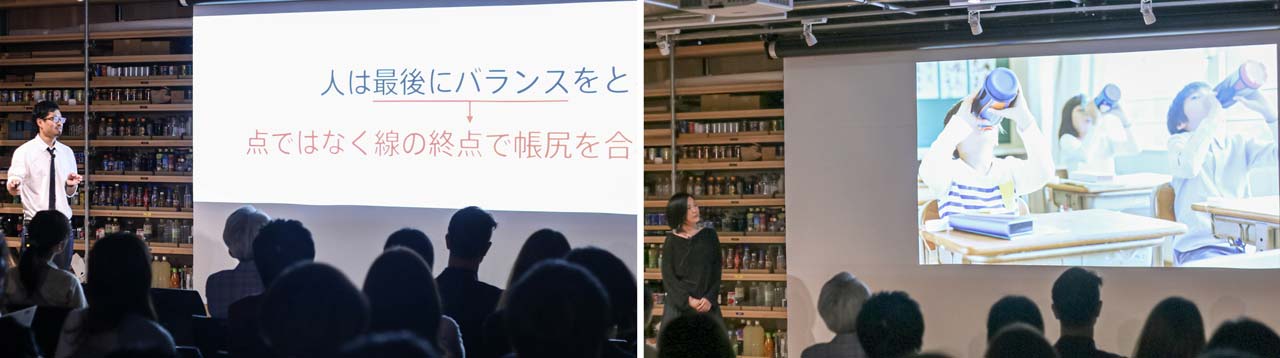
*THE IDEA is an event hosted by the Design Center where people from other departments are invited to watch a number of teams make presentations for independent proposals.
t was through projects like that that people found out I like photography, and that I actually know a bit about it too. I think that's increased the spectrum of my work as well.
It's a great opportunity to find hints and ideas too, right? And it's not like the projects that fall through stay dead — one's actually coming to life right now.
Are you talking about that project?
Yes, that one. It hasn't been made public yet, so we still have to keep it a secret. But when you do come up with ideas that are too avant-garde, they tend to come to life later on anyway. Now that you mention it, your TAG* came from one of those independent projects too, right?
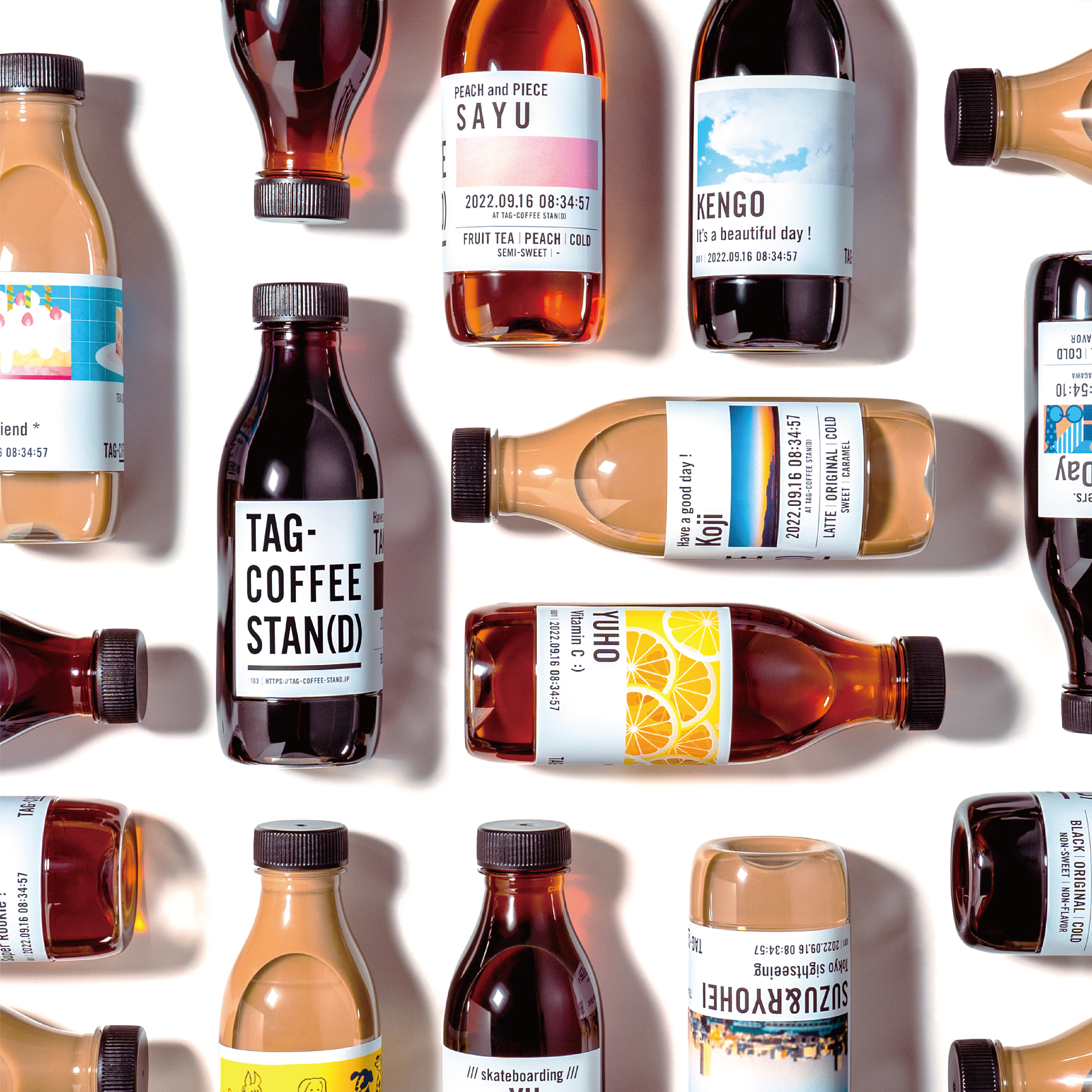
That's right. I sensed there was potential in providing an experience related to a product that landed somewhere in between "mass-produced" and "handmade," where you could customize the contents and design of your beverage. So, we started off with a small shop, like it was a start-up venture. It's a project where we added value to the drink by providing an experience. For our customers, it's easy to personalize something and have it materialize in front of your eyes, making that moment fun! For me, it's fun to see how the service has been received, and make adjustments to improve it. And I'm thoroughly enjoying the process of watching the small endeavor gradually grow bigger.
Projects that focus on experience are the most exciting, right?
When It Comes To Product Development, We're The Best "Counterpart"
That being said, our main battlefield is in the realm of mass-produced products, and even in that theater, it's like we travel from one campaign to another across a number of different genres. From beers and whiskies, to carbonated drinks and health food products. As we work on the different projects, we get to discover new cultures, and it's fun to learn about different customers too. There's a world where people crack open a can of coffee in front of a vending machine alongside the expressway, and there's another world where people savor a drink at a high-end bar in the middle of Tokyo's glamorous Ginza.
When it comes to Product Development, it's vital that you dig deep into the insight about the users. And after working on different brands, and in different categories, the experience you gain helps you notice things. You'll be like, "Hang on. The consumers of Product A look rather similar to those of Product B." For example, our carbonated drinks customers are similar to those who drink Chu-hi (an RTD shochu-based alcoholic beverage.)
And people who drink beer are similar to those who drink coffee. They like to get philosophical, and drink with style — they value their personal degree of satisfaction very highly.
Once you become aware of things like that, you can start bringing analogies from other categories to the table, and that can broaden your horizons. For example, you can take wine's sophisticated image, and add that to other beverages. I think the fact we're able to make discoveries like that is something unique to the Design Center, and it's precisely because we get to work on a wide range of products across a number of different categories. And it also enables us to approach projects with a different perspective compared to that of the Marketing Department.
In a way, you could say that we take a fairly broad approach to our products.
"Broad"? I prefer the word "objective." (laughs) If you stay on one brand for too long, you get too fond of it, and you end up becoming overprotective. But since we get to have relationships with a variety of different brands here at Suntory, I think we're able to maintain an extremely objective perspective. We don't become that attached, in a good way.
But that actually means we can delve deeper too. Since we look at things so objectively, we're able to totally change course, and say: "This way's more fun. Let's try it!" I think the culture at the Design Center provides us with that freedom
I think you're right.
We're Serious, But We Get Crazy. We Speak Rough, But We're Big Softies.
At the Design Center, we share a common way of thinking about things, and we have a definite culture, but at the same time, we're nothing like each other. I always find that intriguing.
There sure are a lot of strange characters here. Some of us are like artisans who want to stay focused on one thing, but we also have people like you who tend to get bored easily. We really do have a wide range of characters.
From newbies who seem to know way too much about old films and TV series, to veterans who love junk food, manga, and anime. I feel that the Center's full of people who want to enjoy a variety of different cultures, and that has nothing to do with age or gender. Perhaps that could be said not only for the Design Center, but for people here at SUNTORY in general.
Or in other words, we all like people.
And there's no divide between genders. We're quite relaxed when it comes to hierarchies too. Our positions vary from project to project, so there'll be times when I'm the Art Director, and I'll get my senpai to do the Design.
There's no real fixed idea of how we're supposed to be and act.
Sometimes I even get the Chief to make data for me. (laughs) And even if it's not my project, when something grabs my eye, I'll say what I think about it — "Is that kerning right?"* And so on. When you're working on a design, you'll also find that a lot of people come up and share their advice as they walk by — "Why don't you try doing that more like this?" — and so forth. Everyone here is always working on a number of different projects, and it feels like nobody ever stands still. The projects themselves progress quickly too. *Kerning: The process of adjusting the spacing in between characters to improve the aesthetics of a design.
You could say that we all like getting things done quickly at the Design Center, and I mean that in a good way too.
We use "both sides of the brain," making full use of both our sensibilities and our rationale, and we multitask as we steam through one project after the after. But it's not as though we're impulsive either. And, of course, some people are a bit more calm and collected.
Now that you mention it, don't you often hear people say that the Design Center is like a zoo? It's probably because we have a range of different characters, and none of us are alike. But I think that's what makes it great here. We're crazy, but reliable. We're serious, but we're crazy.
We say what needs to be said, and we do what needs to be done properly.
You're right. At the Design Center, we're Counterparts to the Marketing Department, and while we share the same objective, we voice opinions from a different perspective, without holding back. And we're expected to question things too. I think the reason we're able to do all that is because we tackle projects head-on, face-to-face, with all we have. We're able say, "But why?" and counter ideas with confidence because we think so extremely seriously about things.
You can't have honest discussions without love. If we didn't raise any objections, I'm sure many projects would proceed very smoothly.
But you've got to have love, right? If you don't approach things with love, you can't say, "Hang on. I don't think that's right."
If we didn't care, we'd just say, "Okay. Sure. Let's do that." We may be more sentimental than I thought.
That may be the one thing we all have in common here. We might be harsh with our words, but we're all full of compassion. We're great at being tsundere (prickly on the outside, but soft on the inside).
I think you wrapped it up nicely. (laughs)